import functools
import os
import random

import matplotlib.pyplot as plt
import numpy as np
import paddle
import paddle.nn as nn
import paddle.optimizer as optim
import pandas as pd
from bayes_opt import BayesianOptimization
from sklearn.decomposition import PCA
from sklearn.metrics import mean_absolute_error
from sklearn.metrics import mean_squared_error
from sklearn.preprocessing import MinMaxScaler


# 设置随机种子
def set_random_seed(seed):
    random.seed(seed)
    np.random.seed(seed)
    paddle.seed(seed)


set_random_seed(42)

# 确保结果文件夹存在
results_folder = "results_out"
os.makedirs(results_folder, exist_ok=True)

# 数据加载和预处理
filePath = "./MP_data_down_loading(train+validate).csv"
df = pd.read_csv(filePath, header=0)

# 数据预处理部分
df_charge_space_group_number = pd.get_dummies(
    df["charge_space_group_number"], prefix="charge_space_group_number"
)
df = df.join(df_charge_space_group_number)
df_discharge_space_group_number = pd.get_dummies(
    df["discharge_space_group_number"], prefix="discharge_space_group_number"
)
df = df.join(df_discharge_space_group_number)

# 去掉所有全为0的列
df = df.loc[:, ~(df == 0).all(axis=0)]

# 保存需要加入PCA之后的特征
df_stability_charge = df["stability_charge"]
df_charge_energy_per_atom = df["charge_energy_per_atom"]
df_charge_formation_energy_per_atom = df["charge_formation_energy_per_atom"]
df_charge_band_gap = df["charge_band_gap"]
df_charge_efermi = df["charge_efermi"]
df_stability_discharge = df["stability_discharge"]
df_discharge_energy_per_atom = df["discharge_energy_per_atom"]
df_discharge_formation_energy_per_atom = df["discharge_formation_energy_per_atom"]
df_discharge_band_gap = df["discharge_band_gap"]
df_discharge_efermi = df["discharge_efermi"]

# 删除不必要的列
df = df.drop(
    [
        "battery_id",
        "battery_formula",
        "framework_formula",
        "adj_pairs",
        "capacity_vol",
        "energy_vol",
        "formula_charge",
        "formula_discharge",
        "id_charge",
        "id_discharge",
        "working_ion",
        "num_steps",
        "stability_charge",
        "stability_discharge",
        "charge_crystal_system",
        "charge_energy_per_atom",
        "charge_formation_energy_per_atom",
        "charge_band_gap",
        "charge_efermi",
        "discharge_crystal_system",
        "discharge_energy_per_atom",
        "discharge_formation_energy_per_atom",
        "discharge_band_gap",
        "discharge_efermi",
    ],
    axis=1,
)

# 分割输入特征和输出特征
x_df = df.drop(["average_voltage", "capacity_grav", "energy_grav"], axis=1)
y_df = df[["average_voltage", "capacity_grav", "energy_grav"]]

# PCA降维
pca = PCA(0.99)
x_df = pca.fit_transform(x_df)
x_df = pd.DataFrame(x_df)

# 加入之前保存的特征
x_df = x_df.join(df_stability_charge)
x_df = x_df.join(df_charge_energy_per_atom)
x_df = x_df.join(df_charge_formation_energy_per_atom)
x_df = x_df.join(df_charge_band_gap)
x_df = x_df.join(df_charge_efermi)

x_df = x_df.join(df_stability_discharge)
x_df = x_df.join(df_discharge_energy_per_atom)
x_df = x_df.join(df_discharge_formation_energy_per_atom)
x_df = x_df.join(df_discharge_band_gap)
x_df = x_df.join(df_discharge_efermi)

# 确保 x_df 的列名都是字符串
x_df.columns = x_df.columns.astype(str)

# 标准化处理
min_max_scaler = MinMaxScaler()
x_df = min_max_scaler.fit_transform(x_df)
y_min = y_df.min()
y_max = y_df.max()
y_df = (y_df - y_min) / (y_max - y_min)

# 数据集划分
len_train_test = int(x_df.shape[0] * 0.9)
x_train, x_test = x_df[:len_train_test], x_df[len_train_test:]
y_train, y_test = y_df[:len_train_test], y_df[len_train_test:]

x_train = np.array(x_train)
x_test = np.array(x_test)
y_train = np.array(y_train)
y_test = np.array(y_test)

# 模型构建函数
def get_model(
    input_shape,
    learning_rate,
    nodes1,
    nodes2,
    nodes3,
    dropout_rate1,
    dropout_rate2,
    dropout_rate3,
):
    model = nn.Sequential(
        nn.Linear(input_shape[0], nodes1),
        nn.ReLU(),
        nn.Dropout(dropout_rate1),
        nn.Linear(nodes1, nodes2),
        nn.ReLU(),
        nn.Dropout(dropout_rate2),
        nn.Linear(nodes2, nodes3),
        nn.ReLU(),
        nn.Dropout(dropout_rate3),
        nn.Linear(nodes3, 3),
        nn.Sigmoid(),
    )

    optimizer = optim.RMSProp(
        learning_rate=learning_rate,
        momentum=0.9,
        centered=True,
        parameters=model.parameters(),
    )
    loss_fn = nn.MSELoss()

    return model, optimizer, loss_fn


# 可视化损失函数
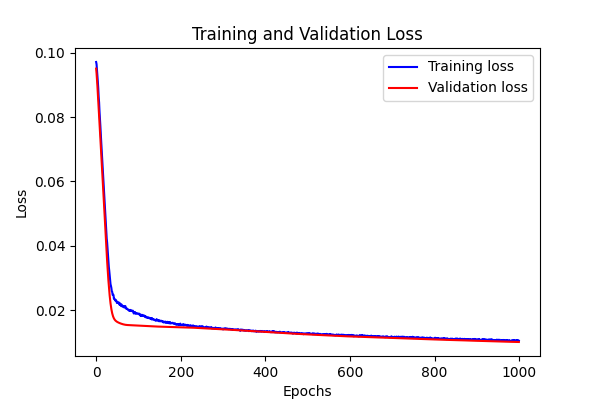
def visualize_loss(history, title, save_path):
    loss = history["loss"]
    val_loss = history["val_loss"]
    epochs = range(len(loss))
    plt.figure(figsize=(6, 4))
    plt.plot(epochs, loss, "b", label="Training loss")
    plt.plot(epochs, val_loss, "r", label="Validation loss")
    plt.title(title)
    plt.xlabel("Epochs")
    plt.ylabel("Loss")
    plt.legend()
    plt.savefig(save_path)
    plt.show()


# 模型训练和验证函数
def fit_model(
    input_shape,
    learning_rate,
    nodes1,
    nodes2,
    nodes3,
    dropout_rate1,
    dropout_rate2,
    dropout_rate3,
    epochs=1000,
):
    model, optimizer, loss_fn = get_model(
        input_shape,
        learning_rate,
        nodes1,
        nodes2,
        nodes3,
        dropout_rate1,
        dropout_rate2,
        dropout_rate3,
    )

    history = {"loss": [], "val_loss": []}
    best_val_loss = float("inf")
    best_model_path = os.path.join(results_folder, "best_model.pdparams")

    for epoch in range(epochs):
        model.train()
        x_train_tensor = paddle.to_tensor(x_train, dtype="float32")
        y_train_tensor = paddle.to_tensor(y_train, dtype="float32")
        preds = model(x_train_tensor)
        loss = loss_fn(preds, y_train_tensor)
        loss.backward()
        optimizer.step()
        optimizer.clear_grad()

        model.eval()
        x_test_tensor = paddle.to_tensor(x_test, dtype="float32")
        y_test_tensor = paddle.to_tensor(y_test, dtype="float32")
        val_preds = model(x_test_tensor)
        val_loss = loss_fn(val_preds, y_test_tensor)

        history["loss"].append(loss.numpy())
        history["val_loss"].append(val_loss.numpy())

        # 保存最优模型
        if val_loss.numpy() < best_val_loss:
            best_val_loss = val_loss.numpy()
            paddle.save(model.state_dict(), best_model_path)

    # 使用训练集数据进行预测
    model.eval()
    y_pred_train_tensor = model(x_train_tensor)
    y_pred_train = y_pred_train_tensor.numpy()

    return model, history, y_pred_train  # 修改返回值为三个


# 贝叶斯优化使用的目标函数
def bayesian_optimization_target(
    input_shape,
    learning_rate,
    nodes1,
    nodes2,
    nodes3,
    dropout_rate1,
    dropout_rate2,
    dropout_rate3,
):
    _, history, _ = fit_model(
        input_shape,
        learning_rate,
        int(nodes1),
        int(nodes2),
        int(nodes3),
        dropout_rate1,
        dropout_rate2,
        dropout_rate3,
        epochs=10,
    )
    return -np.mean(history["val_loss"])


# 初始训练和评估模型
model, history, y_pred_train = fit_model(
    (x_train.shape[1],), 0.0001, 40, 30, 15, 0.2, 0.2, 0.2
)
visualize_loss(
    history,
    "Training and Validation Loss",
    os.path.join(results_folder, "initial_training_loss.png"),
)

# 贝叶斯优化部分
inputs_shape = (x_train.shape[1],)
pbounds = {
    "learning_rate": (1e-05, 0.001),
    "nodes1": (8, 256),
    "nodes2": (8, 256),
    "nodes3": (8, 256),
    "dropout_rate1": (0.1, 0.9),
    "dropout_rate2": (0.1, 0.9),
    "dropout_rate3": (0.1, 0.9),
}

fit_with_partial = functools.partial(bayesian_optimization_target, inputs_shape)

optimizer = BayesianOptimization(
    f=fit_with_partial, pbounds=pbounds, verbose=2, random_state=42
)
optimizer.maximize(init_points=20, n_iter=60)
print("optimizer.max: ", optimizer.max)

# 使用优化后的参数进行最终模型训练和评估
best_params = optimizer.max["params"]
best_model, best_history, y_pred_train_best = fit_model(
    inputs_shape,
    learning_rate=best_params["learning_rate"],
    nodes1=int(best_params["nodes1"]),
    nodes2=int(best_params["nodes2"]),
    nodes3=int(best_params["nodes3"]),
    dropout_rate1=best_params["dropout_rate1"],
    dropout_rate2=best_params["dropout_rate2"],
    dropout_rate3=best_params["dropout_rate3"],
    epochs=1000,
)

# 评估并保存模型
best_model_path = os.path.join(results_folder, "best_model.pdparams")
paddle.save(best_model.state_dict(), best_model_path)

print(f"Best model saved at {best_model_path}")

# 在测试集上评估最佳模型
best_model.eval()
x_test_tensor = paddle.to_tensor(x_test, dtype="float32")
y_test_tensor = paddle.to_tensor(y_test, dtype="float32")
y_pred = best_model(x_test_tensor)
test_loss = nn.functional.mse_loss(y_pred, y_test_tensor)
print(f"Test loss: {test_loss.numpy()}")

# 逆归一化数据并评估性能
y_pred_np = y_pred.numpy()
y_test_np = y_test_tensor.numpy()
y_pred_original = y_pred_np * (y_max.values - y_min.values) + y_min.values
y_test_original = y_test_np * (y_max.values - y_min.values) + y_min.values

y_train_original = y_train * (y_max.values - y_min.values) + y_min.values
y_pred_train_original = y_pred_train_best * (y_max.values - y_min.values) + y_min.values

v_rmse_original = np.sqrt(
    mean_squared_error(y_test_original[:, 0], y_pred_original[:, 0])
)
c_rmse_original = np.sqrt(
    mean_squared_error(y_test_original[:, 1], y_pred_original[:, 1])
)
e_rmse_original = np.sqrt(
    mean_squared_error(y_test_original[:, 2], y_pred_original[:, 2])
)

print(f"V RMSE (Original Scale): {v_rmse_original}")
print(f"C RMSE (Original Scale): {c_rmse_original}")
print(f"E RMSE (Original Scale): {e_rmse_original}")

avg_rmse_original = np.mean([v_rmse_original, c_rmse_original, e_rmse_original])
print(f"Average RMSE (Original Scale): {avg_rmse_original}")

# 绘制性能预测图
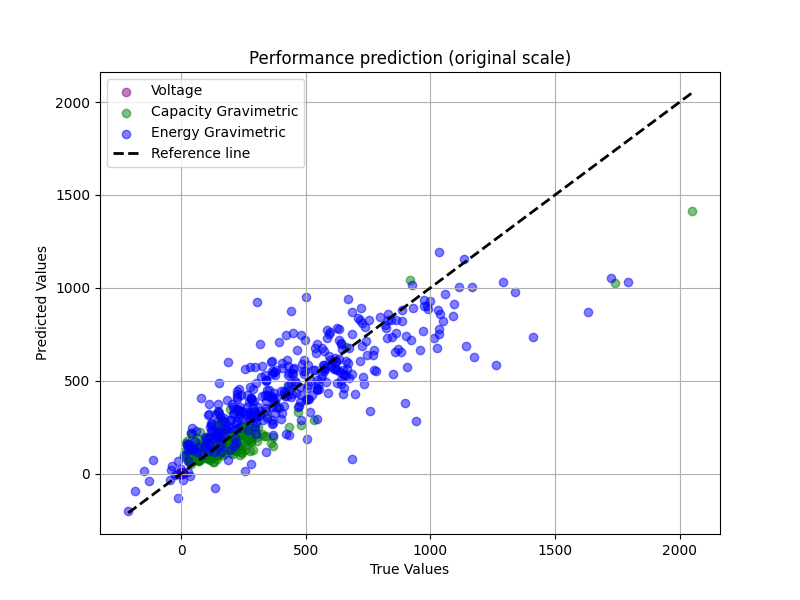
def plot_performance(y_true, y_pred, title, save_path):
    plt.figure(figsize=(8, 6))
    plt.scatter(y_true[:, 0], y_pred[:, 0], alpha=0.5, label="Voltage", color="purple")
    plt.scatter(
        y_true[:, 1],
        y_pred[:, 1],
        alpha=0.5,
        label="Capacity Gravimetric",
        color="green",
    )
    plt.scatter(
        y_true[:, 2], y_pred[:, 2], alpha=0.5, label="Energy Gravimetric", color="blue"
    )
    plt.plot(
        [y_true.min(), y_true.max()],
        [y_true.min(), y_true.max()],
        "k--",
        lw=2,
        label="Reference line",
    )
    plt.xlabel("True Values")
    plt.ylabel("Predicted Values")
    plt.title(title)
    plt.legend()
    plt.grid(True)
    plt.savefig(save_path)
    plt.show(block=False)


plot_performance(
    y_test_original,
    y_pred_original,
    "Performance prediction (original scale)",
    os.path.join(results_folder, "performance_prediction_original.png"),
)

# 绘制性能预测图
def plot_performance_prediction(
    y_true_train, y_pred_train, y_true_val, y_pred_val, title, save_path
):
    plt.figure(figsize=(8, 6))

    # 绘制训练集和验证集的预测值与实际值的散点图
    plt.scatter(
        y_true_train,
        y_pred_train,
        alpha=0.5,
        label="Training set",
        color="purple",
        marker="o",
    )
    plt.scatter(
        y_true_val,
        y_pred_val,
        alpha=0.5,
        label="Validation set",
        color="orange",
        marker="o",
    )

    # 绘制参考线(y=x),表示理想预测结果
    max_val = max(
        y_true_train.max(), y_pred_train.max(), y_true_val.max(), y_pred_val.max()
    )
    min_val = min(
        y_true_train.min(), y_pred_train.min(), y_true_val.min(), y_pred_val.min()
    )
    plt.plot(
        [min_val, max_val], [min_val, max_val], "k--", lw=2, label="Reference line"
    )

    plt.xlabel("True Values [V]")
    plt.ylabel("Predicted Values [V]")
    plt.title(title)
    plt.legend()
    plt.grid(True)
    plt.savefig(save_path)
    plt.show()


# 绘制误差分布图
def plot_error_distribution(
    y_true_train, y_pred_train, y_true_val, y_pred_val, title, save_path
):
    # 计算误差
    errors_train = y_pred_train - y_true_train
    errors_val = y_pred_val - y_true_val

    plt.figure(figsize=(8, 6))

    # 绘制训练集和验证集的误差直方图
    plt.hist(
        errors_train,
        bins=50,
        alpha=0.5,
        label="Training set",
        color="purple",
        density=True,
    )
    plt.hist(
        errors_val,
        bins=50,
        alpha=0.5,
        label="Validation set",
        color="orange",
        density=True,
    )

    plt.xlabel("Prediction Error [V]")
    plt.ylabel("Count")
    plt.title(title)
    plt.legend()
    plt.grid(True)
    plt.savefig(save_path)
    plt.show()


# 使用训练集和测试集的数据来绘制图
plot_performance_prediction(
    y_train_original[:, 0],
    y_pred_train_original[:, 0],  # 使用训练集真实值和预测值
    y_test_original[:, 0],
    y_pred_original[:, 0],  # 使用测试集真实值和预测值
    "Performance Prediction for Voltage (Original Scale)",
    "performance_prediction_voltage.png",
)

plot_error_distribution(
    y_train_original[:, 0],
    y_pred_train_original[:, 0],  # 使用训练集真实值和预测值
    y_test_original[:, 0],
    y_pred_original[:, 0],  # 使用测试集真实值和预测值
    "Error Distribution for Voltage (Original Scale)",
    "error_distribution_voltage.png",
)


# 在测试集上评估最佳模型
best_model.eval()
x_test_tensor = paddle.to_tensor(x_test, dtype="float32")
y_test_tensor = paddle.to_tensor(y_test, dtype="float32")
y_pred = best_model(x_test_tensor)
test_loss = nn.functional.mse_loss(y_pred, y_test_tensor)
print(f"Test loss: {test_loss.numpy()}")

# 逆归一化数据并评估性能
y_pred_np = y_pred.numpy()
y_test_np = y_test_tensor.numpy()
y_pred_original = y_pred_np * (y_max.values - y_min.values) + y_min.values
y_test_original = y_test_np * (y_max.values - y_min.values) + y_min.values

y_train_original = y_train * (y_max.values - y_min.values) + y_min.values
y_pred_train_original = y_pred_train_best * (y_max.values - y_min.values) + y_min.values


# 计算 RMSE
v_rmse_original = np.sqrt(
    mean_squared_error(y_test_original[:, 0], y_pred_original[:, 0])
)
c_rmse_original = np.sqrt(
    mean_squared_error(y_test_original[:, 1], y_pred_original[:, 1])
)
e_rmse_original = np.sqrt(
    mean_squared_error(y_test_original[:, 2], y_pred_original[:, 2])
)

print(f"V RMSE (Original Scale): {v_rmse_original}")
print(f"C RMSE (Original Scale): {c_rmse_original}")
print(f"E RMSE (Original Scale): {e_rmse_original}")

avg_rmse_original = np.mean([v_rmse_original, c_rmse_original, e_rmse_original])
print(f"Average RMSE (Original Scale): {avg_rmse_original}")

# 计算 MAE
v_mae_original = mean_absolute_error(y_test_original[:, 0], y_pred_original[:, 0])
c_mae_original = mean_absolute_error(y_test_original[:, 1], y_pred_original[:, 1])
e_mae_original = mean_absolute_error(y_test_original[:, 2], y_pred_original[:, 2])

print(f"V MAE (Original Scale): {v_mae_original}")
print(f"C MAE (Original Scale): {c_mae_original}")
print(f"E MAE (Original Scale): {e_mae_original}")

avg_mae_original = np.mean([v_mae_original, c_mae_original, e_mae_original])
print(f"Average MAE (Original Scale): {avg_mae_original}")

# 修改后的绘图函数,图中添加 MAE 和 RMSE 信息
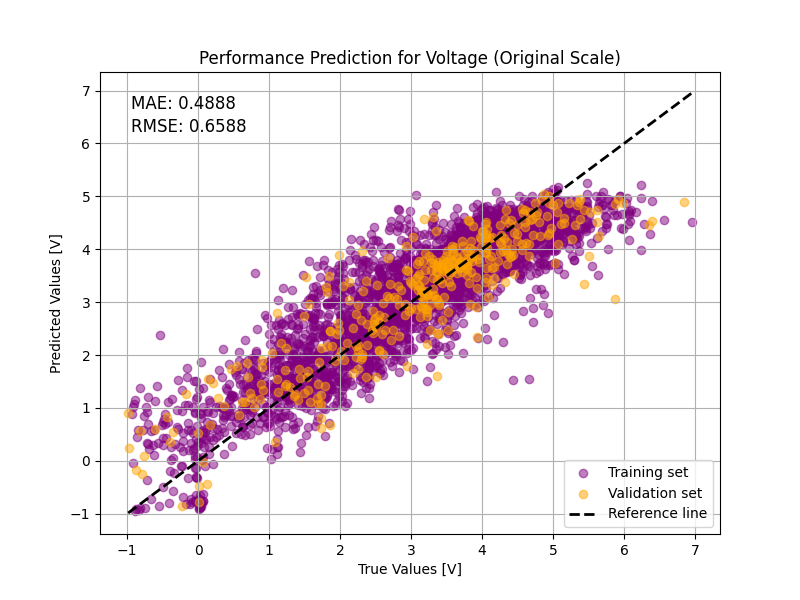
def plot_performance_prediction(
    y_true_train, y_pred_train, y_true_val, y_pred_val, title, mae, rmse, save_path
):
    plt.figure(figsize=(8, 6))

    # 绘制训练集和验证集的预测值与实际值的散点图
    plt.scatter(
        y_true_train,
        y_pred_train,
        alpha=0.5,
        label="Training set",
        color="purple",
        marker="o",
    )
    plt.scatter(
        y_true_val,
        y_pred_val,
        alpha=0.5,
        label="Validation set",
        color="orange",
        marker="o",
    )

    # 绘制参考线(y=x),表示理想预测结果
    max_val = max(
        y_true_train.max(), y_pred_train.max(), y_true_val.max(), y_pred_val.max()
    )
    min_val = min(
        y_true_train.min(), y_pred_train.min(), y_true_val.min(), y_pred_val.min()
    )
    plt.plot(
        [min_val, max_val], [min_val, max_val], "k--", lw=2, label="Reference line"
    )

    plt.xlabel("True Values [V]")
    plt.ylabel("Predicted Values [V]")
    plt.title(title)
    plt.legend()
    plt.grid(True)

    # 在图中添加 MAE 和 RMSE 信息
    plt.text(
        0.05,
        0.95,
        f"MAE: {mae:.4f}",
        transform=plt.gca().transAxes,
        fontsize=12,
        verticalalignment="top",
    )
    plt.text(
        0.05,
        0.90,
        f"RMSE: {rmse:.4f}",
        transform=plt.gca().transAxes,
        fontsize=12,
        verticalalignment="top",
    )

    plt.savefig(save_path)
    plt.show()


# 使用训练集和测试集的数据来绘制图并保存
plot_performance_prediction(
    y_train_original[:, 0],
    y_pred_train_original[:, 0],  # 使用训练集真实值和预测值
    y_test_original[:, 0],
    y_pred_original[:, 0],  # 使用测试集真实值和预测值
    "Performance Prediction for Voltage (Original Scale)",
    v_mae_original,
    v_rmse_original,
    os.path.join(results_folder, "performance_prediction_voltage.png"),
)