Extformer-MoE
Note
- Before starting training and evaluation, please download the ICAR-ENSO dataset and modify
FILE_PATHin the yaml configuration file to the path of the decompressed dataset. - Before starting training and evaluation, please install
xarrayandh5netcdf:pip install requirements.txt - If video memory is insufficient during training, you can specify
MODEL.checkpoint_levelas1or2, then run in recompute mode to trade training time for video memory.
# ICAR-ENSO data pre-trained model: Extformer-MoE
python extformer_moe_enso_train.py
# python extformer_moe_enso_train.py MODEL.checkpoint_level=1 # using recompute to run in device with small GPU memory
# python extformer_moe_enso_train.py MODEL.checkpoint_level=2 # using recompute to run in device with small GPU memory
| Model | Variable Name | C-Nino3.4-M | C-Nino3.4-WM | MSE(1E-4) | MAE(1E-1) | RMSE |
|---|---|---|---|---|---|---|
| Extformer-MoE | sst | 0.7651 | 2.39771 | 3.0000 | 0.1291 | 0.50243 |
1. Background Introduction
The Earth is a complex system. Variations in the Earth system, ranging from routine events like temperature fluctuations to extreme events like droughts, hail, and El Niño/Southern Oscillation (ENSO), affect our daily lives. Among all consequences, Earth system changes affect crop yields, flight delays, trigger floods and forest fires. Accurate and timely forecasting of these changes can help people take necessary precautions to avoid crises or make better use of natural resources such as wind and solar energy. Therefore, improving prediction models for Earth changes (such as weather and climate) has huge socio-economic impact.
In recent years, deep learning models have shown great potential in weather and climate forecasting tasks. Compared with traditional numerical simulation methods, deep learning methods achieve significant improvements in prediction efficiency and accuracy by utilizing emerging technologies such as visual neural networks (ViT) or graph neural networks (GNN) to learn complex mapping relationships between current and future weather or climate states directly from massive reanalysis data. However, extreme events occurring in Earth changes often present characteristics such as long-range spatiotemporal synchronous correlation, diverse spatiotemporal distribution patterns, and sparse extreme value observation signals, which bring many new technical challenges to the construction of deep learning-based Earth system extreme event prediction models.
1.1 Long-range Spatiotemporal Synchronous Correlation
Facing the complex coupled Earth change system, existing technologies based on visual and graph deep learning have many deficiencies in modeling the long-range spatiotemporal correlation presented by extreme weather. Specifically, intelligent forecasting models based on visual deep learning (such as Huawei's Pangu weather model) are limited to calculating information interaction within local regions and cannot efficiently utilize global information from distant regions. In contrast, weather forecasting methods based on graph neural networks (such as Google's GraphCast) can disseminate long-range information through predefined graph structures. However, prior graph structures are difficult to effectively identify key long-range information affecting extreme weather and are susceptible to noise, leading to biased or even incorrect prediction results by the model. In addition, meteorological data of the Earth system generally has massive grid points. While mining global long-range spatiotemporal correlation information, it may lead to a surge in model complexity. How to efficiently model long-range correlations in spatiotemporal data has become a major challenge for Earth system extreme event prediction.
Earthformer, a space-time transformer for Earth system prediction. To better explore the design of space-time attention, Cuboid Attention is designed, which is a generic building block for efficient space-time attention. The idea is to decompose the input tensor into non-overlapping cuboids and apply cuboid-level self-attention in parallel. Since we restrict the O(N2) self-attention to local cuboids, the overall complexity of the model is greatly reduced. Different types of correlations can be captured by different cuboid decompositions. At the same time, Earthformer introduces a set of global vectors that attend to all local cuboids, thereby gathering the overall state of the system. By attending to global vectors, local cuboids can grasp the overall dynamics of the system and share information with each other, thereby capturing long-range correlation information of the Earth system.
1.2 Diverse Spatiotemporal Distribution Patterns
Accurately modeling the diversity of spatiotemporal distribution patterns is the key to improving the prediction of extreme events in the Earth system. Existing methods use shared parameters in both time and space domains, and cannot effectively capture extreme weather feature patterns unique to specific time periods and geographical locations.
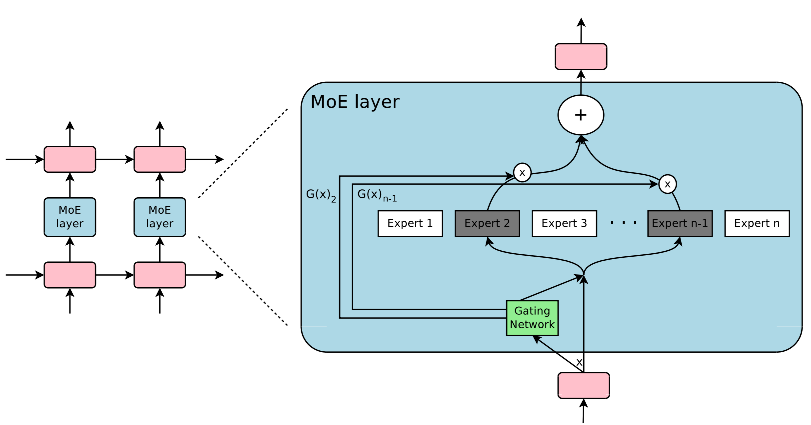
Mixture-of-Experts (MoE) network contains a set of expert networks and a gating network. Each expert network is an independent neural network with independent parameters, and the gating network adaptively selects a unique subset of expert networks for each input unit. During training and inference, each input unit only needs to utilize a small subset of expert networks, so the total number of expert networks can be expanded, enhancing the model's expressive power while maintaining relatively small computational complexity. In the Earth system, MoE can enhance the model's ability to capture spatiotemporal distribution differences by learning unique parameter sets related to time, geographical location, and model input.
1.3 Sparse Extreme Value Observation Signals
The uneven distribution of meteorological data will lead to the model being biased towards predicting frequent normal meteorological conditions, while underestimating extreme conditions with few observations, because regression loss functions commonly used in model training, such as mean square error (MSE) loss, will lead to over-smoothing of prediction results. Unlike imbalanced classification problems with discrete label spaces, imbalanced regression problems have continuous label spaces, posing greater challenges for extreme prediction problems.
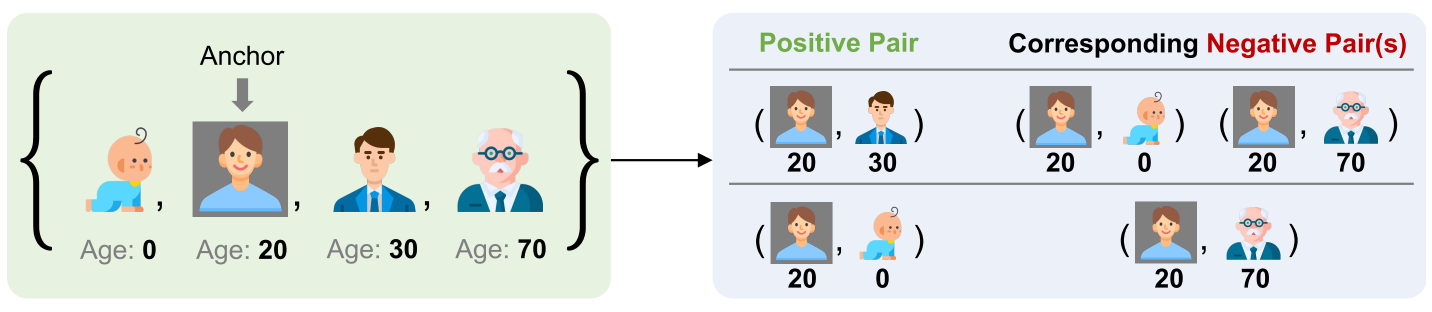
Rank-N-Contrast (RNC) is a representation learning method designed to learn a regression-aware sample representation that sorts the distance between samples in the embedding space based on the distance in the continuous label space, and then uses it to predict the final continuous label. In the Earth system extreme prediction problem, RNC can regulate the representation of meteorological data so that it satisfies the continuity of the embedding space and aligns with the label space, ultimately alleviating the over-smoothing problem of extreme event prediction results.
2. Model Principle
2.1 Earthformer
This chapter only briefly introduces the model principle of EarthFormer. For detailed theoretical derivation, please read Earthformer: Exploring Space-Time Transformers for Earth System Forecasting.
The Earthformer network model uses a hierarchical Encoder-Decoder architecture Transformer based on Cuboid Attention, which decomposes data into cuboids and applies cuboid-level self-attention in parallel. These cuboids further interact with a collection of global vectors to capture global information.
The overall structure of Earthformer is shown in the figure:

2.2 Mixture-of-Experts
This chapter only briefly introduces the principle of Mixture-of-Experts. For detailed theoretical derivation, please read Outrageously Large Neural Networks: The Sparsely-Gated Mixture-of-Experts Layer.
Mixture-of-Experts (MoE) network contains a set of expert networks \(E_1, E_2, ..., E_n\) with independent parameters and a gating network \(G\). Given input \(x\), the output of the MoE network is \(y=\sum_{i=1}^n G(x)_iE_i(x)\).
The overall structure of MoE is shown in the figure:
2.3 Rank-N-Contrast
Rank-N-Contrast (RNC) is a regression method that learns continuous representations through contrast based on the ranking of samples relative to each other in the label space. A simple example of RNC is shown in the figure:
2.4 Training and Inference Process of Extformer-MoE Model
The model pre-training phase trains the model based on randomly initialized network weights, as shown in the figure below, where \([x_{i}]_{i=1}^{T}\) represents input meteorological data of a spatiotemporal sequence of length \(T\), \([y_{i}]_{i=1}^{K}\) represents predicted meteorological data for future \(K\) steps, and \([y_{i_True}]_{i=1}^{K}\) represents true data for future \(K\) steps, such as sea surface temperature data and vertically integrated liquid data. Finally, the mse loss function is calculated for the network model prediction output and the ground truth. In the inference phase, given data of sequence length \(T\), obtain prediction results of sequence length \(K\).
3. Implementation of Sea Surface Temperature Model
Next, we will explain how to implement Extformer-MoE model training and inference based on PaddleScience code. For other details in this case, please refer to API Documentation.
3.1 Dataset Introduction
The dataset uses the ICAR-ENSO dataset processed by EarthFormer.
This dataset is provided by the Institute for Climate and Application Research (ICAR). The data includes historical simulation data from CMIP5/6 models and nearly 100 years of historical observation assimilation data reconstructed by the US SODA model. Each sample contains the following meteorological and spatiotemporal variables: Sea Surface Temperature anomaly (SST), Heat Content anomaly (T300), Zonal Wind anomaly (Ua), Meridional Wind anomaly (Va), data dimension is (year, month, lat, lon). Training data provides Nino3.4 index label data for the corresponding month. The initial field data used for testing are n segments of 12 time series randomly extracted from multiple international ocean data assimilation results, and the data format is saved in NPY format.
Training Data:
The first dimension (year) of each data sample represents the starting year corresponding to the data. For CMIP data, there are a total of 291 years, of which 1-2265 are 151 years of historical simulation data provided by 15 models in CMIP6 (Total: 151 years * 15 models = 2265); 2266-4645 are 140 years of historical simulation data provided by 17 models in CMIP5 (Total: 140 years * 17 models = 2380). For historical observation assimilation data, it is SODA data provided by the United States.
Training Data Label
The label data is the Nino3.4 SST anomaly index, data dimension is (year, month).
The label data corresponding to CMIP(SODA)_train.nc is the three-month moving average of the Nino3.4 SST anomaly index at the current moment, so the data dimension and dimension introduction are consistent with the training data.
Note: The three-month moving average is the average of the current month and the next two months.
Test Data
The initial field (input) data used for testing are n segments of 12 time series randomly extracted from multiple international ocean data assimilation results. The data format is saved in NPY format, with dimensions (12, lat, lon, 4), 12 is time t and past 11 moments, 4 are predictors, stored in the order of SST, T300, Ua, Va.
In the training of the EarthFormer model for the ICAR-ENSO dataset, only Sea Surface Temperature (SST) is trained and predicted. Training SST anomaly observations for 12 steps (one year), predicting SST anomalies for up to 14 steps.
3.2 Model Pretraining
3.2.1 Constraint Construction
This case solves the problem based on data-driven methods, so it is necessary to use SupervisedConstraint built in PaddleScience to construct supervised constraints. Before defining constraints, you need to first specify various parameters used for data loading in supervised constraints.
Data loading code is as follows:
Among them, the "dataset" field defines the Dataset class name used as ExtMoEENSODataset, the "sampler" field defines the Sampler class name used as BatchSampler, batch_size is set to 16, and num_works is 8.
The code for defining supervised constraints is as follows:
| examples/extformer_moe/extformer_moe_enso_train.py | |
|---|---|
The first parameter of SupervisedConstraint is the data loading method, here train_dataloader_cfg defined above is used;
The second parameter is the definition of loss function, here a custom loss function is used;
The third parameter is the name of the constraint condition, which is convenient for subsequent indexing. Here it is named Sup.
3.2.2 Model Construction
In this case, the sea surface temperature model is implemented based on the ExtFormerMoECuboid network model, expressed in PaddleScience code as follows:
| examples/extformer_moe/extformer_moe_enso_train.py | |
|---|---|
The parameters of the network model are set through the configuration file as follows:
Among them, input_keys and output_keys represent the names of input and output variables of the network model respectively.
3.2.3 Learning Rate and Optimizer Construction
The learning rate method used in this case is Cosine, and the learning rate size is set to 2e-4. The optimizer uses AdamW, and groups parameters to use different weight_decay, expressed in PaddleScience code as follows:
3.2.4 Validator Construction
During the training process of this case, the training status of the current model will be evaluated using the validation set at certain training round intervals, and SupervisedValidator is needed to construct the validator. The code is as follows:
The SupervisedValidator validator is quite similar to SupervisedConstraint, the difference is that the validator needs to set evaluation metric metric, here custom evaluation metrics MAE, MSE, RMSE, corr_nino3.4_epoch and corr_nino3.4_weighted_epoch are used.
3.2.5 Model Training and Evaluation
After completing the above settings, you only need to pass the instantiated objects to ppsci.solver.Solver, and then start training and evaluation.
3.3 Model Evaluation
The code for building the model is:
| examples/extformer_moe/extformer_moe_enso_train.py | |
|---|---|
The code for building the validator is:
4. Complete Code
| examples/extformer_moe/extformer_moe_enso_train.py | |
|---|---|
1 2 3 4 5 6 7 8 9 10 11 12 13 14 15 16 17 18 19 20 21 22 23 24 25 26 27 28 29 30 31 32 33 34 35 36 37 38 39 40 41 42 43 44 45 46 47 48 49 50 51 52 53 54 55 56 57 58 59 60 61 62 63 64 65 66 67 68 69 70 71 72 73 74 75 76 77 78 79 80 81 82 83 84 85 86 87 88 89 90 91 92 93 94 95 96 97 98 99 100 101 102 103 104 105 106 107 108 109 110 111 112 113 114 115 116 117 118 119 120 121 122 123 124 125 126 127 128 129 130 131 132 133 134 135 136 137 138 139 140 141 142 143 144 145 146 147 148 149 150 151 152 153 154 155 156 157 158 159 160 161 162 163 164 165 166 167 168 169 170 171 172 173 174 175 176 177 178 179 180 181 182 183 184 185 186 187 188 189 190 191 192 193 194 195 196 197 198 199 200 201 202 203 | |